What an experience we have had with our nine-day trip to Broken Hill!
Hopefully over the next couple of weeks I will make the time to share the best of our stories, photos and videos from this amazing outback city.
For the moment, though, a little background information may assist my international followers to orient themselves:
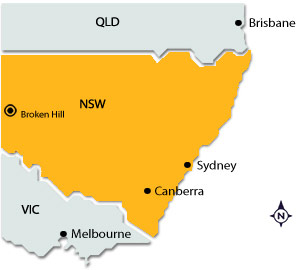
Source: NSW Trainlink
Broken Hill is the most westerly city in the state of New South Wales. It is around 1150km (715m) from the state capital, Sydney, unless you are an energetic crow, in which case you may fly in the straight line for which they are reputed, and thus reduce the trip to a mere 935km or 581 miles.
In terms of regional boundaries, Broken Hill lies within the Far Western area – although most people simply refer to it as part of the “outback”. For their part, Broken Hill residents have their own classification system. Class A – for those born and bred there; Class B – married into Class A or long time settlers, and everyone else is Class C – or simply, “away people“.
It sits very close to the South Australian border, and is “only” 500km from the SA capital of Adelaide. Consequently Broken Hill, and nearby Silverton, operate on Central Standard Time (CST) which is half an hour behind the rest of New South Wales.
From Sydney, the fastest way to get to Broken Hill is to fly in the Saab 340 twin-engine turboprop propeller 36 seater operated by Rex Regional Airlines. Two flights a day, one direct, and one via Dubbo, and both are expensive options.
The most flexible method is to drive yourself, on mostly long, straight, sealed roads, with a gradually changing scenery and whatever music you have loaded up to keep you company. It’s customary to acknowledge other drivers along the way. How you do that is up to you: an enthusiastic wave, a “queenly” twist of the wrist – both work – but even lifting a lazy finger off the steering wheel will suffice.
The daily “public transport” option is XPT train to Dubbo and bus from there. The privately owned train option is the weekly Indian Pacific – which we will take in mid-May.
Then there is the state-owned NSW Trainlink service which leaves Sydney on a Monday morning and arrives back there on a Tuesday evening. And, for this, our first visit to Broken Hill, what else would we choose but “The Outback Xplorer“?
And also for the edification of my international followers, here is an extremely truncated and not terribly reliable potted history:
The affectionate name for Broken Hill is the Silver City, for the very obvious reason that its roots lie in mining of that metal, plus ore and zinc. Its European history begins with Captain Charles Napier Sturt (1795 – 1869) who in 1844 had the brilliant idea to go looking for a great inland sea. He had already established that the path of several western flowing rivers all ended up in the Murray River and ultimately entered the sea in the Coorong in South Australia – a point which is still critical today and will be mentioned in many future posts. If you saw the 1976 Australian film Storm Boy you will be familiar with that area.
Anyway, no inland sea. In fact, a lot of desert PLUS a mountain range around Broken Hill which so got in his way that he named them the Barrier Ranges. He also noted the odd “broken” shape of one of the hills. (I love this knack of English explorers for naming things according to the “school of the bleeding obvious”).
Within twenty years, pastoralists were moving into the area, displacing 40,000 years of the local Aboriginal people, the Wiljakali and their neighbours the Barkindji . One of the stations which sprang up was Mt Gipps, owned by George McCulloch. He employed a boundary rider named George Rasp, who, one day in 1883, was out doing his job when his horse kicked up a stone that he took to be tin. Long story short, it turned out that he had found the largest known silver-lead-zinc deposit in the world.
By the end of 1885 the Broken Hill Proprietary Company (BHP) was floated on the stock exchange. Over the decades it expanded to steel making, wartime aircraft, ship building, as well as mining and smelting operations further afield, but it actually closed the ‘Big Mine’ at Broken Hill in 1940, effectively cutting its ties with the town. In 2001 it merged with Billiton (a Dutch Indonesian company with similar history) to become BHP Billiton.
BHP was not the only mining company even in the early days. All the same, many people still associate Broken Hill with them, even though others such as Pasminco and Perilya have since followed.
Broken Hill is also famous for its artists!
And as the site of several film sets, such as Mad Max II and Priscilla Queen of the Desert – which in turn is spurring a local festival known as BROKEN HEEL.
I hope you enjoy coming along for the ride, starting with our 2016 Monday 7th March 6am departure from Sydney Central Station on The Outback Xplorer (start here).
All aboard! 🙂
Garrulous Gwendoline
 GWEN WILSON The Reluctant Retiree
Pingback: 1. Mt Hutton (near Newcastle) to Tamworth | The Reluctant Retiree
Pingback: Day 2 of the The Indian Pacific Sydney – Perth (Part One) | The Reluctant Retiree
Pingback: City Sights and Heritage Tour of Broken Hill run by Silver City Tours | The Reluctant Retiree
Since I know almost nothing about Australia, this was a fascinating post. I really enjoyed hearing about the area and your sidebars of how to get there and make the most of your journey. I had to chuckle about the waving to other motorists, my husband often does the lazy finger thing when we are in a rural or camping area. The more city type folks don’t appreciate this but something about being in the Great Outdoors an acknowledgement seems appropriate.
LikeLiked by 1 person
There always seems to be a bit more time, and the expectation of common courtesy when away from the cities, don’t you think? You are no longer invisible. I am not sure if you have had a chance to catch the next post abut the actual train trip. It includes some video snippets you might find interesting. And more posts to come!
LikeLiked by 1 person
Thanks for setting the stage- I’m looking forward to the trip.
LikeLiked by 1 person
Thanks for the feedback. I just this moment posted about the train trip up. More to come each day!
LikeLike
Thanks for the useful history/geography lesson. I look forward to the rest
LikeLiked by 1 person
Informative as ever Gwen!
Looking forward to the trip! Xx
LikeLike
Thanks Kerri!
LikeLike
Ashamed to say I’ve never been there Gwen, doubt I ever will now, that and “The Alice” ,
LikeLiked by 1 person
Great! Now I have an excuse to load videos and lots of photos so you can come on the trip vicariously. Bill and I are trying to make a deliberate decision to see more of our own country. We haven’t seen the Alice for example!
LikeLike
Always forget, but of course Australia is a continent and not just a country. Even NSW is bigger than the UK. Looks like a great road trip especially for the folks who enjoy driving.
LikeLiked by 1 person
Oh yes, it is a big, big country. I remember once, as part of a group of four of us living in London, I spent a weekend in the Cotswolds. At the end, they were telling their friends – you should travel with Aussies, we really WENT places. lol. I had stopped the car every couple of miles, because I was so taken with how much there was to see in such a confined area.
LikeLike
‘Confined’ – yup that’s small island living!!!
LikeLiked by 1 person
But it is a beautiful island of many contrasts and a rich history 🙂
LikeLike
I think the weather has had a big impact on the British over the centuries – so changeable and unpredictable.
LikeLiked by 1 person
Oh yes. I remember when I first arrived being struck how every plan for an outing ended with – and if it rains, we will . . .
LikeLiked by 1 person