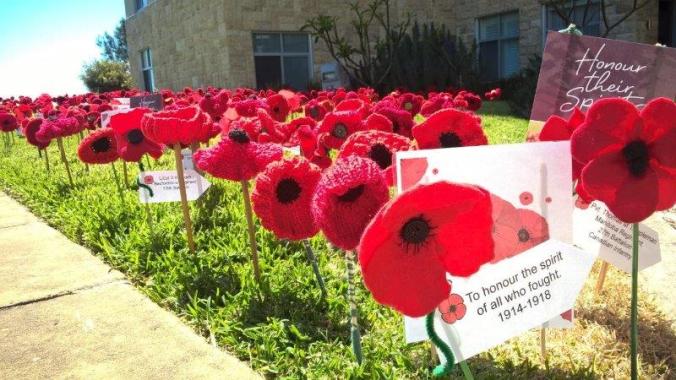
The call went out for residents to knit or crochet 100 red poppies to commemorate 100 years since the Armistice . . . in the end 430 poppies were “planted” on a section of our lawn.
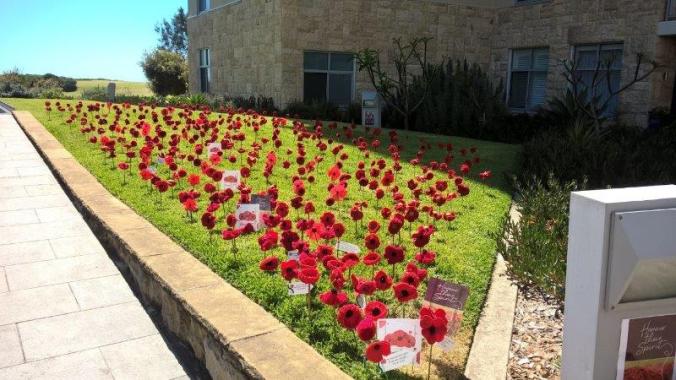
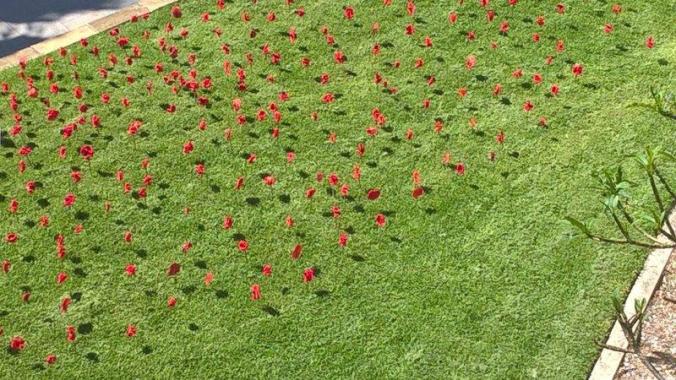


Today, at 11am on the 11th day of the 11th month, we stopped for our traditional one minute of silence to remember all those who sacrificed in the “war to end all wars”. After which, one of our group read the famous poem by John McCrae, In Flanders Fields.
In his poignant post this morning, fellow blogger Don Ostertag paid homage to this poem, and what it means in the context of this conflict, and others that have followed. You may care to read his thoughts, here.
Around the world, there are millions of people whose lives have been directly affected by WW1. In Australia, the records of Australian servicemen and women who served in the first Australian Imperial Force (AIF) are preserved in the National Archives, and fully digitised for anyone to access. I have read around fifty of those in the course of research for family members and friends.
My Aunty Nan, born 1915, was one of those who lost her father before she even had the chance to know him. Alexander Richardson Kyle, a Scot, was a private in the 3rd Battalion 1st AIF. He was born Belfast, Ireland; trained as an engineer’s assistant in Glasgow, Scotland; and was working in the Clyde Engineering works in Sydney, Australia at the time of his 1917 enlistment (22nd March). He found his final resting place, “1800 yards West North West of Bellicourt, France” after being killed in action at Hargicourt on 18th September 1918.
He left behind in Australia his Scottish wife and two infant Australian-born daughters. His widow received a parcel of his personal effects comprising 2 purses, 1 razor strop, 3 razors, cards, 2 pairs gloves and 1 belt. Some years later she also received his service medals.
My aunt kept a photo of her father beside her bed until the day she died (aged 92).
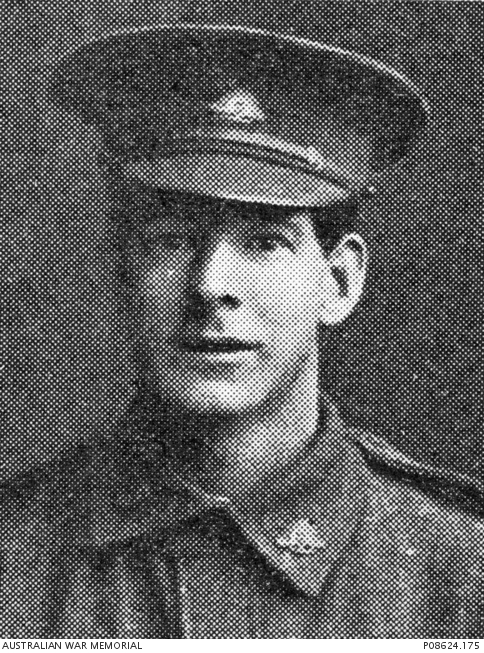
Studio portrait of 7497 Private Alexander Richardson Kyle, 3rd Battalion of Granville, NSW. An Engineer’s mechanic prior to enlisting, he embarked from Sydney aboard HMAT Euripides (A14) on 31 October 1917. While on patrol, he was killed in action at Bellicourt, France on 18 September 1918 and buried nearby, aged 31. Post war his grave was not located and he is remembered with honour on the Villers-Bretonneux Memorial, France.
(source https://www.awm.gov.au/collection/C1242255?image=1. Copyright Expired).
Lest We Forget
 GWEN WILSON, Author, aka The Reluctant Retiree
Almost everything here in Berlin is tied to war – one way or another, and as you see from the input and comments on your post it’s a passionate subject for anyone who has had any connection with it. My parents met at a dance during the war. He was a dashing captain. The are so many “stories” about the Berlin Gate, including the one about Napoleon stealing the chariot riding goddess on top and shipping her back to Paris.
LikeLiked by 1 person
I can imagine the constant reminders of a difficult history, but, somehow that Napoleon story had passed me by. I thought I had heard something about the chariot being turned in the opposite direction during the Cold War, so possibly I got muddled up.
What a lovely way for your parents to meet. Just today I went to a talk by an author (Eleanor Limprecht), whose latest book (The Passengers) is based on the Australian war brides who married US servicemen and moved to the States.
LikeLiked by 1 person
The statue was returned after the French were defeated. The goddess inside the chariot was renamed from Eirene – Goddess of Peace – to Victoria (for victory, of course)… The Brandenburg Gate is on Pariser Platz – the irony being “victory over Paris” :o). I think it takes spending an extended amount of time in Berlin to even begin to understand the many nuances of the city. Guides tell fascinating stories of people who somehow escaped over the wall. The Memorial to the Murdered Jews of Europe is one of the most graphic places I’ve ever experienced. Berliners embrace the horrors of their past realizing things could change again if people are not mindful. There is strict monitoring of Schengen country visitor visas these days (90 days total) and so I will be moving to Dubrovnik in late December as it is not a Schengen country. After my first visit to Croatia a few years ago, I was interested in spending more time there. I wanted to go to Sicily but cannot enter another Schengen country until April 2019. Depending on how things go, maybe Albania next? In 2021 they will change visa requirements so you can apply for a visa that is good for three years in any Schengen country. I am finding Berlin quite challenging for a solo woman traveler but it’s a good experience and there is so much to explore and experience. So far, the weather has been very mild but that will surely change un December.
LikeLiked by 1 person
I had noticed some settling-in challenges for you in Berlin, which seems surprising given it must be so much more organised than some of the countries you’ve visited, but then I’ve never stayed for an extended time, and even then, the most recent time was at least a decade ago.
Dubrovnik is interesting. I used to live in a village outside of Rijeka when Tito was still alive, but I never had the money to go to Dubrovnik. And then the war came, and its fabric was devastated. I finally got there a few years ago,
https://garrulousgwendoline.wordpress.com/2013/06/30/dazzling-dubrovnik-2/ and at first glance it appears to be doing very well. But look closer and the scars of the war are still there.
There are many memoirs of living in Dubrovnik during the war. I found this one particularly poignant, despite its rugged translation https://www.goodreads.com/book/show/18719140-a-dubrovnik-war-story
LikeLiked by 1 person
Gwen – I was in Croatia in June 2013 as well – Split (and surrounding islands like Hvar), Zagreb, and lesser known spots like Opǎtija (the Pearl of the Adriatic) near Rijeka. It was beautiful and I remember Učka Mountain and some of the old medieval villages. It was a long trip (again) from Turkey to Greece, Croatia, Czech Republic, and Hungary…. Somehow, I only passed through Dubrovnik so this time I will explore and hopefully it will be warmer than Berlin. Know what you mean about the “war feeling”…. It’s there but it takes a while to “get it”. During my last trip to Prague I really learned lots about how some people were deeply affected and Prague wasn’t even damaged so much by bombings. Thanks for the post link and book reference.
The world today seems to be headed toward destruction – sad. I have no idea what to expect in South Africa this time. The news makes it seem horrid with the land redistribution horror stories and it hasn’t even officially started yet. Not sure how accurate the press coverage is either.
Seems border issues are everywhere in the world – including South Africa. I cringe every time I hear the news and what’s happening in the US. It’s so toxic and dysfunctional. The tragic California fires are the worst – they really got hit hard this year.
LikeLiked by 1 person
Love your post, Gwen.. And your poppies. And thanks for your kind words about my 11/11/1918.
Here in the US we dropped the title of Armistice Day and renamed it Veterans day, that gets a bigger audience for the sales, Our president went to France to honor the day, but it was raining out so he didn’t go to the Veterans cemetery like the other world leaders did.
LikeLiked by 1 person
Thank you Don. I did mean to warn you I intended to link your piece (and ask your permission), but time has gotten away from me these last few days, so I made an executive decision. I didn’t think you would mind.
Here in Australia we now call it Remembrance Day, but I wanted to show my stubborn streak. After all, the particular significance of this year is the 100th anniversary of the Armistice. It’s a significance that does appear lost on your President. You can be sure his aversion to rain has made world headlines. Heaven help him if he actually had to contend with the mud of the Western Front.
Having said that, I note our Prime Minister did not attend. Of course, we are turning them over so fast at the moment, perhaps the aides didn’t know in which name to book the airline ticket. We were represented by our Governor-General, who also happens to be a retired military man – General Sir Peter John Cosgrove, AK, MC. And he has managed to hold on to his current position for almost five years. So perhaps he was the better choice in any case.
LikeLike
Echoes of the war years, when many women knitted socks for the soldiers. As I get older, I find myself more disgusted with even the notion of war. How horrible that humans still have to send their sons and daughters into war to kill others or/and be killed. I honour those returned, but the great sadness is about those who didn’t. We have to find a better way to reconcile differences between nations.
LikeLiked by 2 people
I couldn’t agree more Cynthia. But the more I study history, the more I am struck by the relatively few years of peace in between various wars. I have little hope that politics and economics will ever learn the way of reconciliation.
LikeLiked by 1 person
Such an interesting and sad post, Gwen. Then reading all the comments I can’t help but worry and think and wholeheartedly hope that humanity has learnt from these world wars.
LikeLiked by 2 people
Territory, economics, industrial development – all powerful motivators to perpetuate the myths of the warmongers. I hold little hope we’ll ever learn.
LikeLiked by 1 person
Sadly, I agree with you, but don’t you think collectively women might just possibly be able to find a better way.
LikeLiked by 1 person
Interesting thought. But to achieve that, don’t we need more women in decision-making positions who are prepared to stand together? In our current Australian ministerial inner government, out of 26 positions, only five are held by women; and of those, only two have “meaty” roles i.e. foreign affairs and environment.
And harking back to WW1, as much as there were women campaigning against the war (eg Vida Goldstein & Adela Pankhurst), there were others actively campaigning for expressing patriotism by enlistment and even conscription.
I think this ability for women to see things from different viewpoints, coupled with a tendency to round on each other when those viewpoints become too divergent, is one of our “weaknesses” that groups with an agenda use against us to divide and conquer.
I’m not expressing this viewpoint coherently, as I am writing this comment at the end of a long day 🙂
LikeLiked by 1 person
I agree with you that various factions do turn on each other, but I think the key is education. Particularly in WW1 most women, certainly in UK, were a product of the class they were born into. I think in the past 100 years more women have had access to a better education and social mobility has also helped people question what were once thought of as immutable truths. I must admit with the current global political atmosphere I’m not too hopeful as we seem to be going backwards – men and women. As I type I have the radio on and hear our parliament behaving very badly as they turn on (admittedly a rather useless) Theresa May. It’s the Brexit Titanic hitting the iceberg moment!
LikeLiked by 1 person
I’m not on the ground with Brexit, but I do have some sympathy for Theresa May. It seems all the architects of Brexit disappeared into the woodwork when the hard job of implementation was on the table, leaving it to her to pick up the pieces. There is no way she can satisfy all sides. And when it’s finished, whatever the outcome, she’ll be cast aside and labelled a failure.
Here in local government, we have our female Minister for the Environment, Melissa Price, being accused of having told the former Kiribati president Anote Tong, a nominee for the Nobel Peace Prize and in Australia to talk about climate change, that she had her “chequebook” ready because it was “always about the cash” when Pacific Island leaders came to Australia, and “how much did he want?”
To which a female colleague in the SAME party, Senator Concetta Fierravanti-Wells, the former minister for international development and the Pacific, wrote an article in a leading newspaper, saying “It is regrettable that our good work and practical support for the Pacific has been recently damaged by an Environment Minister on “L-plates”. It demonstrated a lack of diplomacy, understanding and respect for one of our nearest neighbours.”
Of course, if what Melissa Price said is true, then what the Senator said is also true-ish. But seriously. They are in the same party, and work in the same building. Do you not think they could have had that conversation behind closed doors?
LikeLiked by 1 person
Reading your account of that incident makes me realise why they make dramas about politics – there’s so much real-life material to work with! I can’t decide whether it is politics in general that remodels decent women into overambitious, treacherous schemers or that it’s only overambitious, treacherous schemers that enter the political arena in the first place. On Theresa May, sadly a fifth-rate talent has risen to lead our country by default.
LikeLiked by 1 person
I think that chicken and egg scenario is a fifty/fifty answer. There MUST be those who enter politics with the best intentions and morals, only to be moulded by the system until even they barely remember their original character.
LikeLiked by 1 person
Hi Gwen, I love your eloquent writing and this piece really touched my heart. Recently my wife and I had the honour of visiting a number of the major war sites in France and Belgium back in September. Among them was Villiers – Bretonneux. I wish I had known at the time and I could have found the memorial stone and taken a photo for you. Stay well & keep writing
Cheers Tim
LikeLike
What a lovely surprise to hear from you Tim, and thank you so much for your kind comments. Visiting the war sites must have been a very poignant experience. One of these days I will visit for myself. Did you know the Australian War Memorial projects the names of veterans on its walls? For the timetable, you can search the roll of honour here https://www.awm.gov.au/about/our-work/projects/roll-honour-name-projections all the best Gwen
LikeLike
NIce post Gwen ❤️
LikeLike
Thanks Kerri xx
LikeLike
Well done Gwen!! Excellent photos too! We saw you there, as we listened to the Last Post on the TV at the Canberra service. My Father was on the beaches at Dunkirk in the 2nd World War – that is also a very well remembered occasion!
LikeLiked by 1 person
Thanks JoJo. You’ll notice one of the photos was taken from your balcony. I never realized your father was part of the Dunkirk evacuation. What a terrifying experience that must have been.
LikeLike
My maternal grandfather served 22 years in the Royal Navy, as did his 4 brothers, all survived, WWI one actually survived the battle of Jutland, and immediately after the war migrated to the USA , on the first day there he was killed stepping off the sidewalk /footpath, he apparently looked right to see if there was anything coming and got skittled by an auto-mobile coming from his left.
My grandfather was the sole survivor when his ship, a destroyer was sunk in the English Channel; he’d been taken ashore an hour before sailing time with appendicitis, when he recovered he volunteered for submarine service, chances of survival were small then; he wanted to join his shipmates at the bottom of the ocean.
A different breed of men. WWI
LikeLiked by 2 people
Amazing stories, and yes, you’re right, a different breed indeed.
LikeLiked by 1 person
LikeLiked by 1 person
The ‘Great War’ impacted us all eventually. Our grandparents had vivid memories of the soldiers who went overseas and never came back—some of them were beloved family members. So many men from our sparsely populated country (Canada) were lost. An aunt, who died in her eighties three years ago said that she was too young to marry when the war started, but she stayed single because there were “no men left” when she became of age. It was a major travesty, and we should never forget!
LikeLiked by 3 people
I think our countries had very similar experiences and statistics e.g. our total population was less five million, our force were all volunteers, 416,809 men enlisted, 60,000 were killed and 156,000 wounded, gassed, or taken prisoner. In addition to this count are the military nurses and other women who served in non-recognised fields. And we had the same problem with a lack of marriageable men.
Plus think of all the children raised without a father, and the impact that had on future generations. Or those who fathers returned but were terribly damaged both physically and mentally. Horrific repercussions.
In fact, in my family, (not on account of WW1) I have to go back to my great-grandmother, born 1854, to have a generation that did have a father in situ, which in my opinion, explains a lot of the choices we “daughters” went on to make. (Just throwing that in an as additional observation)
LikeLiked by 1 person
Great post Gwen. My father served in the infantry during WWII February 1941 – November 1945 and saw some horrific things. As a little girl, I remember his nightmares after returning from active duty. I keep his complete Captain’s uniform with all medals and badges!
LikeLiked by 2 people
I have several DVDs with archival footage which graphically illustrates how tough the fighting was in so many places where US troops served. Your father must have also been in the Pacific War judging by that finishing date. But did you mean to say Feb 1942? Otherwise I’d be curious to know where he served before Pearl Harbour.
LikeLike
Those are the dates on the plaque I arranged with the government to have placed at his grave site. I believe February 1941 was his induction date and he was likely still in the US – Minnesota. He contracted malaria in the Pacific and told horrible stories of how captured soldiers were tortured at night so troops could hear their screams…. Believe it or not, he also told some humorous stories. I was always his most captive audience.
LikeLiked by 2 people
I don’t know where my reply of yesterday has disappeared to, but to recap my memory. I was saying how interesting I found your additional info, as I had been focused on the thousands of US servicemen who enlisted voluntarily after Pearl Harbour and was not thinking of those who had signed up months before. So please excuse my ignorance. In my defence, there are many in the US who do not realise that Darwin was first bombed only two months later, so fast was Japan’s advance. So we still have so much to learn about each other’s involvement in the war.
I am surprised your father spoke of his experiences, as generally they did not – for such reasons as the example you gave. My husband’s father would only say, “it’s over”. Malaria also was so common. In the 80s I had a returned serviceman boss who was frequently downed by its returned bouts. Once it’s in your system, you never get rid of it, as I’m sure your father experienced. Just as well he found reasons to be upbeat also 🙂
LikeLike