Today (Saturday 30th April 2022) was the last working day of my writer’s residency at Bundanon, the former home of artists Arthur and Yvonne Boyd. We will ship out of here tomorrow (that’s a reference to how wet it has been), via the actual art museum (we are at the ‘Artist’s in Residence’ section) where we will give a talk on our experience, work, and writing in general.
My newest favourite word is ‘iteration’. Rather than refer to my manuscript by which version I am up to, I will henceforth say ‘iteration’. I feel that better represents the tinkering I have done over the years. Saying version, in my opinion, suggests to the listener that massive changes have taken place. On the other hand, in hindsight, some massive changes have taken place, and yet, sometimes it seems as if I have merely come around in a big circle.
I first began Louisa’s Legacy in September 2016 as an historical novel closely based on my great-grandmother’s life. I showed it to the agent who had got me the publishing contract for my memoir I Belong to No One. She suggested I dump the first chapters which reimagined a sailing ship voyage from England to Australia circa 1880 (queue massive grief over losing all that research). I had already dumped massive sections which dealt with her father’s death and mother’s bankruptcy (queue massive grief over losing all the research I did on – with thanks to Agnes Ashe – ‘Death & Funerals in the Victorian era’, as well as what little I could find on a woman becoming insolvent in 1876). When I resubmitted the revised manuscript, my agent liked the first half, but not the second which included scenes from Louisa’s true to life death in an ‘Asylum’ for destitute women. She said my heroine was too much of a victim for modern taste (i.e. too much like ‘Tess of the D’urbevilles).
Then I tried it as a form of novelised memoir, and fell in a heap two-thirds through. So then I went back to the historical novel concept. I still put Louisa on a ship, but this time I kept the focus on why. Apparently having your heroine run away with a married man will also alienate the reader from the get go. It was another ‘no’ from the agent.
So then I turned to a professional editor, who suggested I break the manuscript in two. Great idea. Which I had already unsuccessfully pitched to my agent, but went ahead with this time anyway. And somehow, through the editing process and our enthusiastic rapport (with my editor, not my agent 🙂 ), the second half turned into a hybrid memoir/faction novel called Florence & Lucy. A chapter of ‘me’ and my search for these two women, alternates with a chapter of my novelised take on their lives at the time. That non-standard approach is a hard sell to mainstream publishers, so at the moment it is homeless. Well, actually, it has a home. It’s a green USB stick.
Splitting a manuscript in two is not the easiest thing to do, at least for a newbie writer such as myself, but about six months back I turned my attention back to the first half, Louisa’s Legacy. Having maintained my rage about sticking to the truth, and therefore exhausting all I I wanted to say in F&L, this time I was happy to ‘bend’ some of the facts of Louisa’s life to fit into a pure historical novel. I mean to say that some of things that I have happening to Louisa were not actually her experiences. But they were other women’s, so from that respect, they are still true to my research. And by the way, Louisa still dies in the Asylum for destitute women, but it happens in F&L, where she is not the central protagonist, so it is not the same letdown for the reader. Well. Actually. It is a letdown, but at that point we are more invested in how Lucy will cope going forward. (Hope you’re still with me at this point.)
Anyway, I arrived at this residency without having had the time to work on Louisa’s Legacy for a couple of months. I wasn’t sure exactly where I had left Louisa, or even whether her spirit was still waiting for me. But, lo! Six days of solid writing, and, would you believe, I am within coo-eee of yet another complete iteration of what is mostly her story. Louisa still gets here on a sailing ship by the way, but on board with her is the man she will eventually marry in Australia. He is a stowaway (true) and Louisa is a cabinmate with his wife and baby son (half true – his wife was a paying passenger). But when that wife dies about eighteen months after arriving in Australia, the stowaway marries Louisa and she becomes stepmother to the baby son (all true).
Last Monday I had no idea how the manuscript would finish, whether I would attempt an ending that would set the reader up for Florence & Lucy, or whether I would go down my agent’s path, and give Louisa an improbably happy ending. Then, around mid-afternoon today, it just dropped in. I was only a few paragraphs from typing ‘the end’ when we broke for our regular afternoon group conflab session. But if the idea doesn’t morph into something else overnight, then we leave Louisa, after having suffered one set back after another, finally reaching a point of happiness and hope for the future. Then Florence & Lucy picks up about twelve years later, when we see that life for their mother (Louisa) is once again throwing up what, despite her best efforts, prove to be insurmountable challenges, but by then we are invested in what happens to her two daughters.
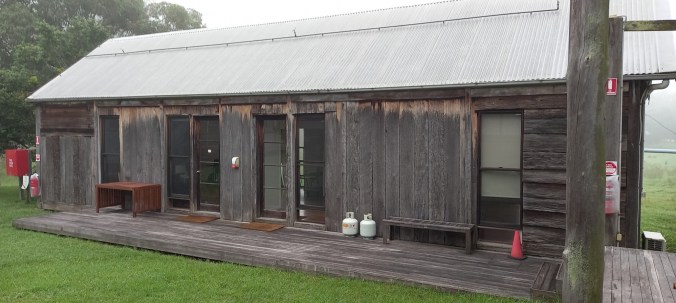
Gosh! I had no idea I would write all this. How weird. Albeit virtual, this must be a version of debriefing 🙂 I hope you enjoyed the ramble, and in the meantime, leave you with a photo of the barn in which I have been writing for the last week.
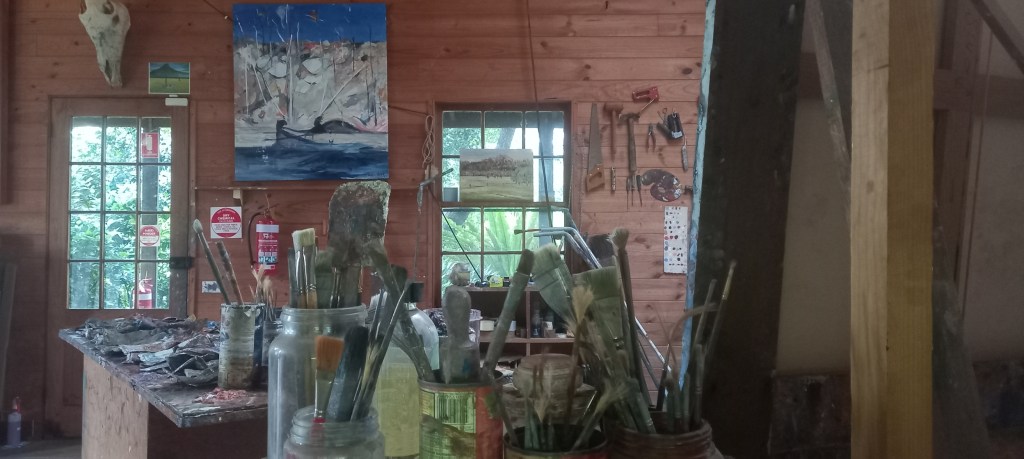
And here is the studio in which Arthur Boyd painted.
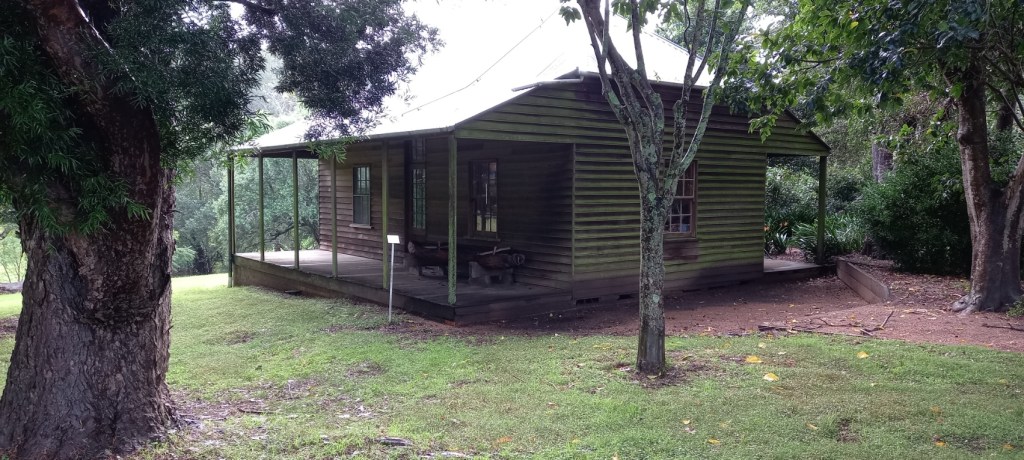
More photos from my daily walks in my next post. It’s definitely bedtime now. Hope I can sleep. The road into this retreat is 9klm (6 miles) of dirt and gravel that has been washed away in all the rain and storms of the last two months. Heavy trucks hired this week to do some other remedial earthworks have caused further damage. So now the onsite caretaker will lead us out in the morning in a convoy of six cars, to assist us negotiate the potholes, ruts, and ravines that is meant to be a road. He left me today with the words, ‘Don’t let it intimidate you.’ Huh! If Louisa’s Legacy hasn’t beaten me yet, then that drive has no chance!
 GWEN WILSON, Author, aka The Reluctant Retiree
Nice article…. Great tips regrading wrapping. You provided the best information which helps us a lot. Thanks for sharing the wonderful information.
LikeLike
Pingback: Garrulous Gwendoline On Writing | The Reluctant Retiree
That was a very, very interesting read. Thanks so much for taking the time to reveal the intricate, manoeuvres required to forge a manuscript into two iterations valued by your editor and agent. Also, I think you’ve answered a question my sister and I have been asking over the past few years about the ceaseless requirement for happy endings. Book publishing is obviously a business, but it’s a pity they only consider works that fit their preferred formula. Heaps of luck to get these two into print.
LikeLiked by 1 person
Thank you Agnes. After I have accumulated a satisfactorily demoralising collection of rejections, I may consider ‘backing myself’ and going for a thing called assisted publication. Meantime I will continue to rail against the obligatory happy ending. Apparently, it is all on account of COVID. The publishers tell me that readers are looking for escapism, whatever that means.
LikeLiked by 1 person
Oh I see Covid is being used as an excuse for anything and everything these days. So according to publishers readers have only just realised that people really do die in the end, Covid or no Covid, always, and there are no true happy endings. This ‘happy ending’ obsession I thought pre-dated Covid. At least my sister and I seem to have been moaning about it for years. Surely there should be a wide variety of fiction not only to suit different readers, but even to suit the different moods of the same reader. I suppose there’s fashions in publishing like everything else. Good luck with whichever publication route you choose.
LikeLiked by 1 person
Thank you Agnes. I am heartened by the feedback from a number of those who also say they do not need happy endings!
LikeLiked by 1 person
Wow! What a marathon, and it still isn’t finished. I loved hearing how it all got examined from the inside out, changed (or not changed), expanded and/or whittled down, etc. Your writing ‘office’ is truly remarkable–definitely not for the faint of heart. I hope it all ends with a contract in your hot hands. I want to read it!
LikeLiked by 1 person
It is so hard to get traditionally published in Australia, but I am nowhere near exhausting the possibilities. And then I can drop down a notch and invest in myself with assisted publication. So there is hope yet. Hope is all any of us have, am I right?
LikeLiked by 1 person
That’s right! Hope and the possibility of an “accidental” conversation somewhere that turns into gold…. 🙂
LikeLiked by 1 person
Now there’s a thought. I really need to lift my networking game. x
LikeLiked by 1 person
Happy Mother’s Day! 💐
LikeLiked by 1 person
Thank you 🙂
LikeLiked by 1 person
What a journey you have had with Louisa’s story. Interesting enough, I have just finished “Devotion” by Hannah Kent and there’s a fair section of voyage on a ship in that one. I guess agents are always thinking about things from the marketing perspective, but I always tend to prefer the truth rather than improbable happy endings. Wonder how many great “truthful” stories never see the light of day because they don’t fit the marketing box. Sounds like you had a profitable time, and I have enjoyed the pictures of the locals.
LikeLiked by 2 people
The Australian publishing market is so tight, so there is no choice for mainstream publishers than to stick with what sells. At the other end of the spectrum, though, the idea that self-publishing equals vanity publishing is fading.
HK’s Devotion has divided readers, hasn’t it? It’s on my TBR list. I must bring it higher up the list and see how she handled the voyage.
LikeLiked by 1 person
I know that some readers haven’t liked the magical realism in Devotion, but I really enjoyed it. I have Lutheran-German ancestry so I loved the historical part of the story. I wonder if some people struggled with the spirituality of the story, especially if they have no religious background themselves.
LikeLiked by 1 person
Sounds like a great place for a writing retreat, I’ve enjoyed reading about it. The details you’ve described that you had to cut sound extremely interesting to me (I am on the trail of my own family history). No-one told Peter Carey to remove voyages from ‘Oscar and Lucinda’ – or if they did, he didn’t take any notice. Perhaps it’s time for a new agent? Maybe a British one 🙂 Peter Carey’s agents are https://www.rcwlitagency.com/about-us/
LikeLiked by 1 person
Thanks for that tip, Eileen. I’ll look into them more closely. Very tempting to have representation in England.
To be fair to my agent, her point was the sailing ship story has been done, and that I was ten years too late with mine. Peter Carey beat me to it 🙂
LikeLiked by 1 person
Technically, William Golding beat Peter Carey to it by 8 years (To the ends of the Earth – a sea trilogy 1980) 🙂
LikeLiked by 1 person
That agent certainly made life difficult for you. Your ramblings are always engaging
LikeLiked by 1 person
Oh dear, my poor agent. I really have ill represented her. I hope to do a follow up post today. More ramblings 🙂
LikeLiked by 1 person
First point – I absolutely hate the word ‘iteration’. And I understand why it is suggested that you change it here and change it there but did you go through all that with I Belong to No One? Because that came across as you pouring your heart out and it was ‘un-put-downable’. I hope you have kept some of that.
LikeLiked by 1 person
Now I plan to use iteration at every opportunity 🙂 Like in Monty Python’s The Knight’s Who Say Ni.
And yes, absolutely I Belong to No One was a similar process. There are twelve ‘iterations’ on my computer before it got a publishing deal, and then more after that.
I’ve decided to write a follow up post to elaborate a few of the points of the first.
LikeLiked by 1 person
But I won’t cut down the tree.
LikeLiked by 1 person
Because you don’t have a herring?
LikeLike
While we are at it, ‘iteration’ is a tinny word whereas version is a ‘woody’ word.
LikeLiked by 1 person
Now you are going too deep even for me 🙂
LikeLike
Monty Python and woody words. “Bosom”, according to Monty is a nice woody word. “Tit” is a tinny word. I like woody words. “Iteration” is a tinny word.
LikeLiked by 1 person
Ah, I get it now. Live and learn, hey!
LikeLike
Going to Bundaron must have been so worthwhile for you Gwen to gain the inspiration for your novel. Can’t wait to read it ! Hope your car survives the potholes and ravines on the way out ! Say goodbye to the wallabies and kangaroos for me xx
LikeLiked by 1 person
They say bye, nye back to you Marion 🙂 Mercifully, the rain had eased, so the trip out was reasonable by comparison. And the caretaker who escorted us showed no sign of flinching, so we had no choice but to take it at his pace. Now I’m a qualified rally driver.
LikeLiked by 1 person
Another string to your bow Gwen!
LikeLiked by 1 person
Hope I get to use it again sometime 🙂
LikeLiked by 1 person
That looks like a great place to write. I can also see why an artist would live there!
Hope you took that drive safely!
LikeLiked by 1 person
It was very productive. I was paragraphs away from completing that ‘iteration’. And we were escorted out by the caretaker. I was the car immediately behind him, and he took it at a clip. I’ve always wanted to be a rally driver.
LikeLiked by 2 people
It”s 3am & I’ve just read your “ramble”. Best middle of the night read ever! Cannot wait for the book!!
LikeLiked by 2 people
It’s revealing to hear the real life struggles a writer must go through to deliver that polished product into our greedy little hands. I’ll be lined up with you, JoJo, to buy this book.
LikeLiked by 1 person
Yaay! Two confirmed pre-sales 🙂
LikeLiked by 1 person
Thank you, JoJo. Wouldn’t it be wonderful if the book was published and another 120 people turned up to the launch? What a day that was!
LikeLike
Sounds like a winner, Gwen. You sold me but I am far from a my-way-or-the-highway editor. Fingers crossed.
LikeLiked by 1 person
I’ve become very philosophical about the process, Don. I was going to write you a long answer, but I think I may actually do a follow up post.
LikeLike
Ah, can’t wait to read what I inspired.
LikeLiked by 1 person
Hopefully coming up today!
LikeLiked by 1 person
I’m finding it very interesting to read how your novel has been changed by editors and agents while you feel you have to stick with the truth. I know exactly how you feel. Also dumping a section where you invested so much time and research is frustrating. We don’t always want books to follow a certain path but we still read them so I don’t see why the truth has to be changed. Getting your writing to publishing stage sounds like a lot of hard work. I hope your book reaches a satisfactory conclusion for all concerned.
LikeLiked by 3 people
Thank you so much Linda. I’m thinking of doing a follow up to that last post, about my publishing journey in general.
LikeLike