Friday, 13th October 2023.
Donning her alter-ego as a firefighter on a 24-Hour shift, our niece headed off very early from her equestrian business at Blue Top Farm. Bill was up, but I’m no early bird, so it was a couple of hours later before we locked the house and drove up a narrow, winding, steep, bitumen road to the Oxley Scenic Lookout for a view of the city of Tamworth and the Peel River Valley (population around 62,000). Here it is.

Next we needed fuel, coffee, and – would you believe it – a stop to shop in Aldi for something that Bill missed out on back at home. You might know Aldi offers one-off weekly specials on all kinds of weird things that have nothing to do with groceries. So, you could say we drove 600 kilometres (375 mi) to buy a tyre-pump compressor.
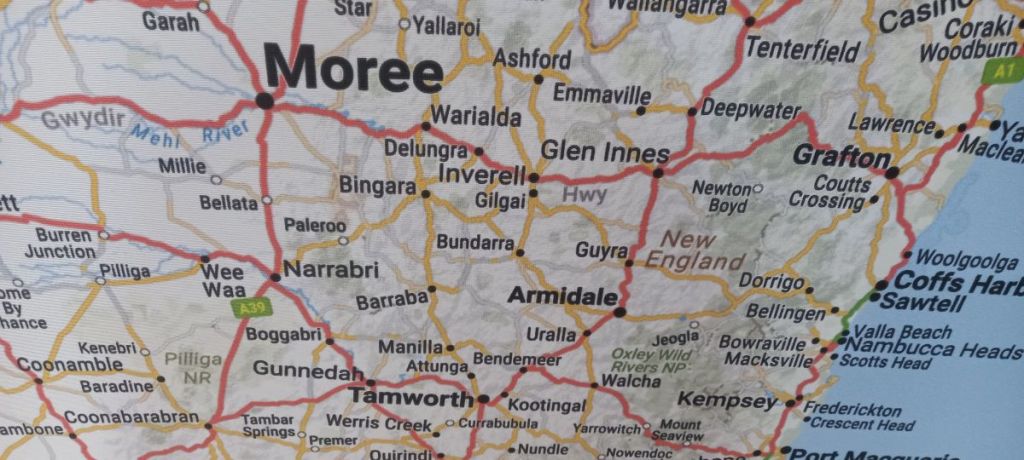
Then, it was on to Moree (urban population about 7,000) located in northern NSW, 628 km (400mi) north-west of Sydney, getting close to the Queensland border. Our northerly route on a series of secondary roads known as Fossickers Way (B95) – because of the proliferation of gemstones on this route – passed through towns such as Attunga, Manilla, and Bingara until it intersected with the Gwydir Highway, where we switched west (ignoring a turnoff to Warialda east of the intersection). As usual we’d swapped drivers halfway but it’s not a long trip – 280klm/175mi – so we were lucky that our motel room was available on arrival. We unloaded and were at the tourist office by 2pm.
Shock, horror! We were quickly informed that the main drawcard – the public access Artesian Hot Springs were temporarily closed. The town’s hot artesian spa bath complex evolved from a bore which was originally sunk in 1895 to obtain irrigation water. The closure put a hole in our plans, as we had booked two nights intending to soak our cares away. So for the rest of the day we fell back to a tried-and-true activity, an exploration around town. As it turned out, Moree still has many historic buildings of interest, and a pictorial follows. But first, a bit about Moree.
Moree is situated on the banks of the Mehi River with the Gwydir River also close by. Moree’s flood plains are some of its greatest natural assets, but it means most of the town is subject to flooding. As we drove around, we saw many houses raised on stilts, and at least one business offering the service of lifting homes.
The area has been inhabited by the Kamilaroi people for thousands of years, but when the British came around 1850 the local Aboriginals were herded into missions, and later, after the establishment of the “Aboriginal Protection Board” in 1883 they were moved to reservations. Before that, as early as 1837, squatters moving into the area to set up large pastoral estates often came into conflict with those original inhabitants. You can guess who came off worse in that exchange. Many squatters were intent on annihilation. This is a typical story in country areas all across Australia.
Today around 25% of the population of Moree identifies as Aboriginal or Torres Strait Island descent, and it is significant that we were in town at this time, as Australians were about to vote in a referendum to enshrine a First Nations “Voice” in our Constitution (I might write more about that separately).
The flood plains of Moree bring broken-down basalt and volcanic black soil from the western slopes of the Great Dividing Range making this rich agricultural country. Crops include cotton, pecan nuts, oil seeds, sorghum, canola, oats, barley, fava beans, mung beans, chickpeas, as well as the traditional wheat, and harvests can be bumper – just as long as they are not destroyed by flood.
Tours of cotton farms and a pecan nut farm are available at the right time of the year – which is not October! Both are harvested from around March.
Which brings me back to our afternoon tour of the various architecture in town. (Text first, then photo/s).
- Constructed in 1900 for a Dr Magill, this building in the Federation Arts and Craft style originally served as a surgery and hospital until becoming the Moree Club about twenty years later. Now it is a LightHouse Church and in need of some refurbishment. Note the T-Shaped detail on the timber windows and the projected gables which provide ventilation.
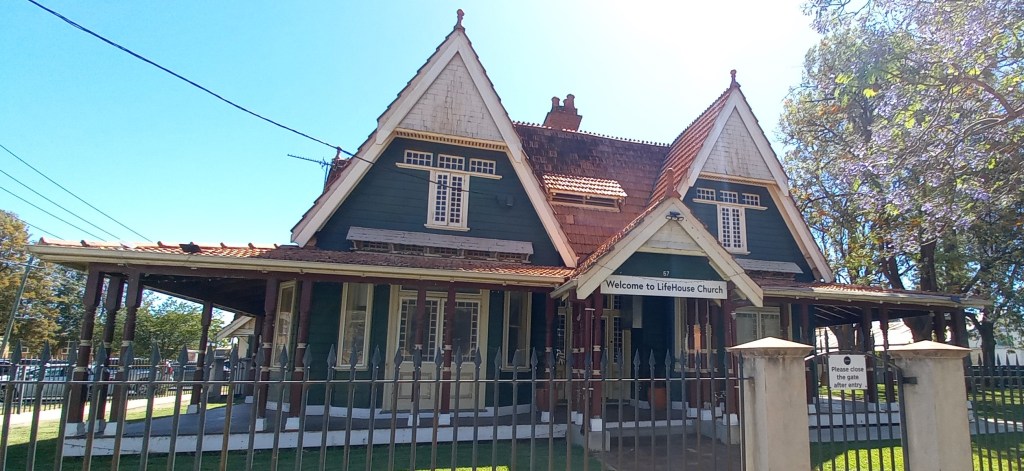
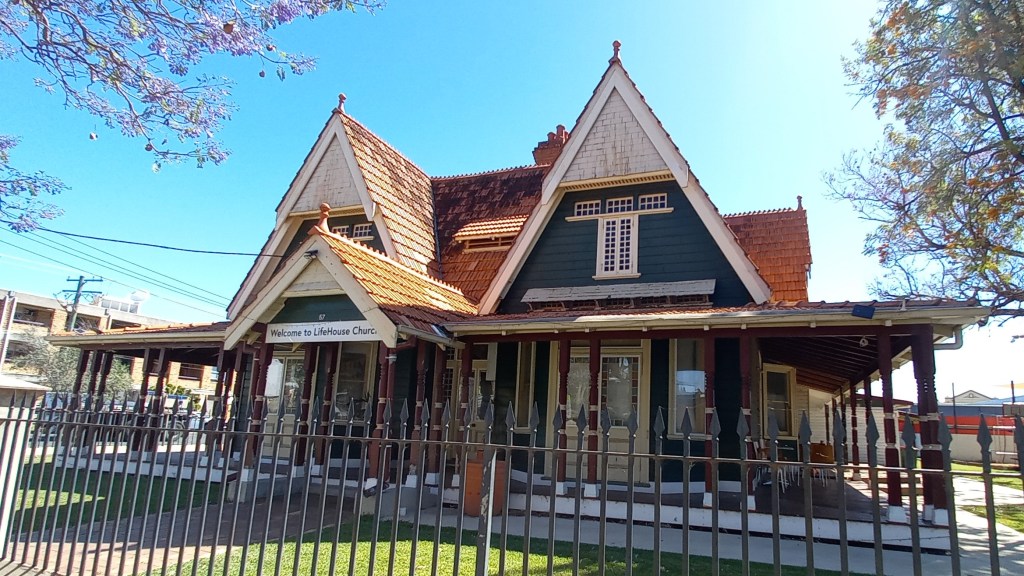
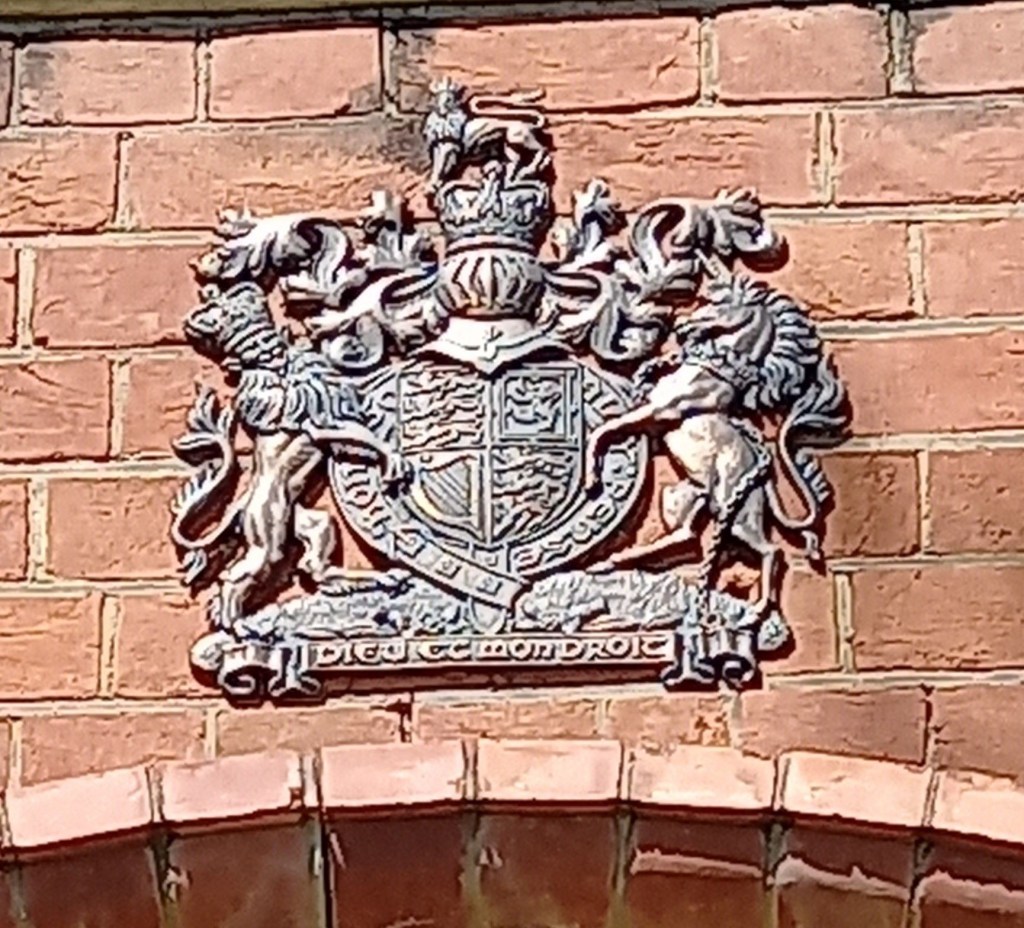
2. In every country town, the Courthouse always seems to be the most imposing building. Moree’s was constructed in 1903 in the Edwardian period. Demonstrating our obsession with “Mother England”, even though we had recently federated, the crest on the entrance archway is the coat of arms of the United Kingdom and bears the motto of the monarch “Dieu et Mon Droit” – God & My Right.

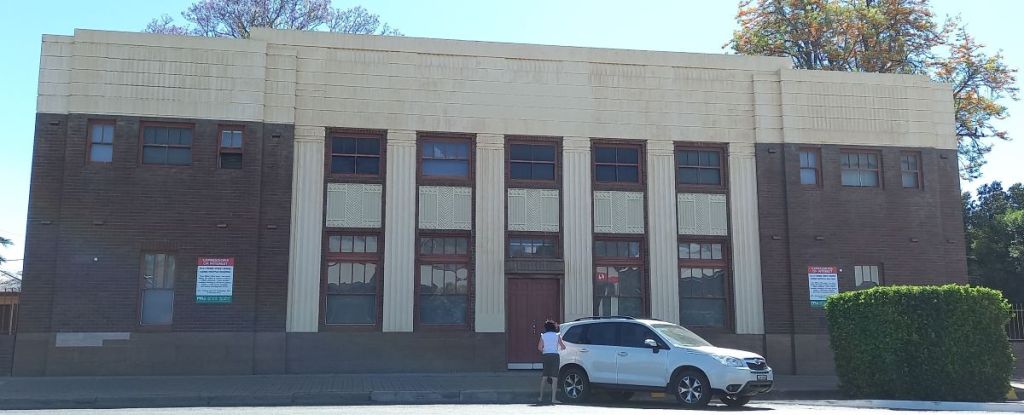
3. If you look closely at this rather nondescript symmetrical building with a polished red granite base, you will notice it has some Art Deco style decorations. The reason I show it, however, is that it was originally the Bank of New South Wales, which later merged to become the Westpac Bank, but now, typical of what is happening in many country towns, the bank has closed up shop, forcing customers into online banking and leaving the building to languish on the “For Lease” market. It looked better when the facade detail was painted in cream-yellow and bore Westpac’s logo.
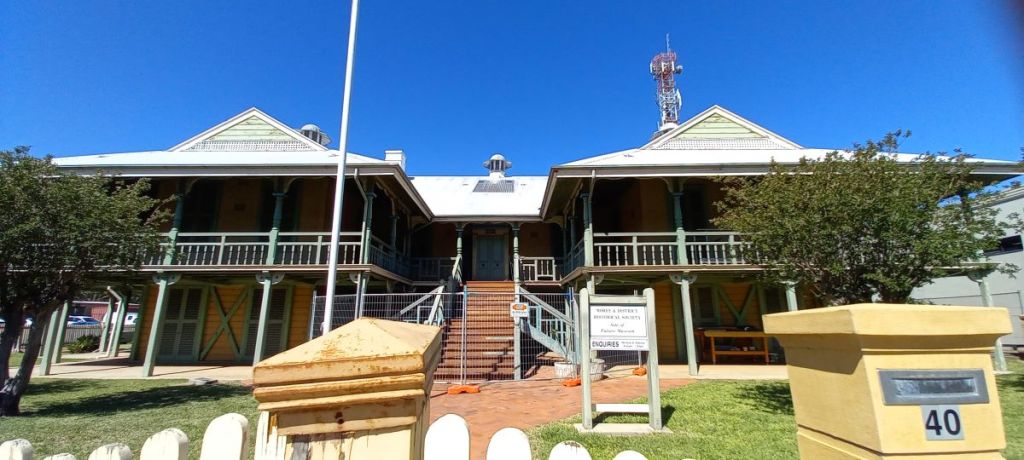
4. This building, which is currently being renovated, has an interesting history. Built for the Department of Lands in 1893, it used commonly available materials of timber and corrugated iron. It was raised in height (probably to protect valuable land title records from floodwaters) around 1902 at which time a third verandah was built to connect two existing ones, and thereby giving it this pleasant balance. Then it narrowly survived a fire in 1980. I wonder if the current works are due to the floods of earlier this year?
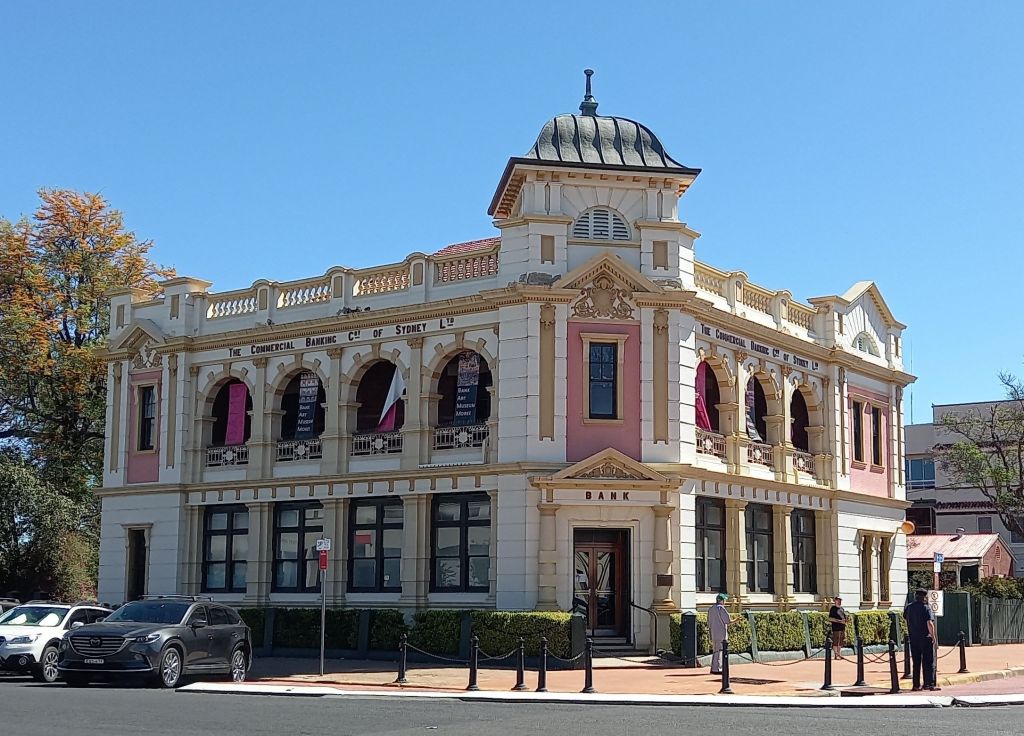
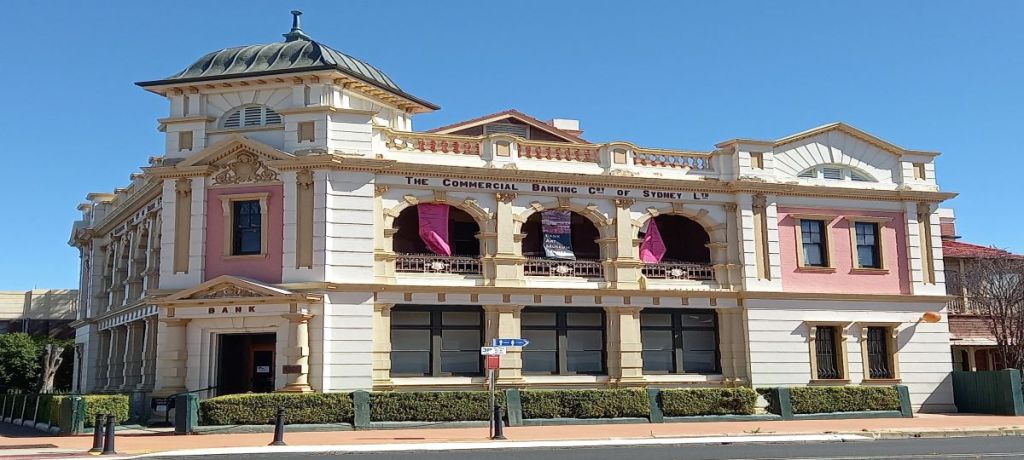
5. Here is the jewell in the crown, demonstrating Moree’s prosperity in the early 20th century, and occupying a prime corner position in the central part of town. Constructed in1910 for the Commercial Bank of Sydney it sports many architectural embellishments, including Art Noveau iron lace work on the second storey verandah. It is now an important regional art gallery, which we visited the next day.
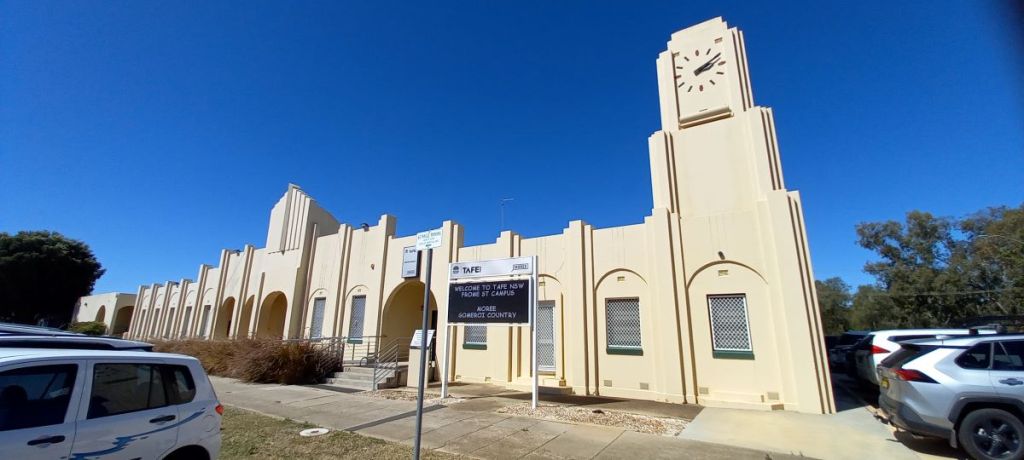
6. On the opposite corner, while predating the bank, being constructed in 1902 – although little remains of that original building – what is now a TAFE (Technical & Further Education College) was originally the Council Chambers, and after WWII the Returned Services Club. Exactly when it morphed into Art Deco Style was not clear to me, but the bays and arches continued around the corner.
That was a sample of buildings from the self-guided Moree Heritage Walk, now here a few random shots taken enroute.
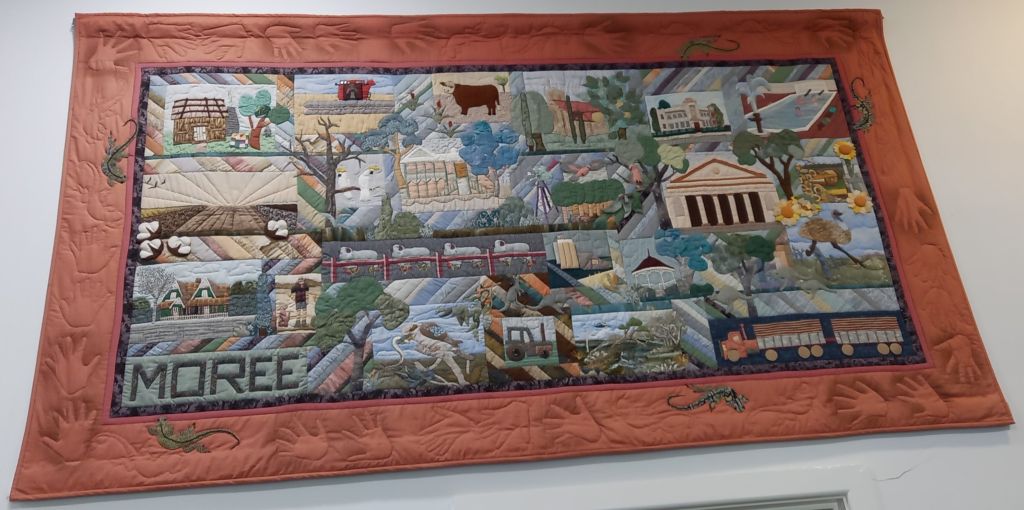
The Moree Quilt on show at the Visitors Centre depicts historical and agricultural aspects of Moree life.
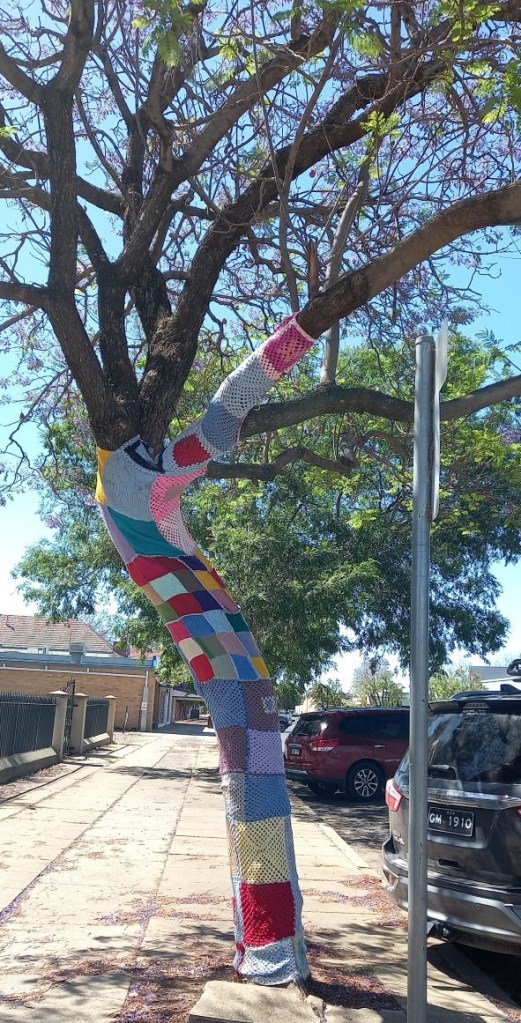
I have no idea why some trees were wrapped in crocheted rug squares but I’m open to enlightenment.
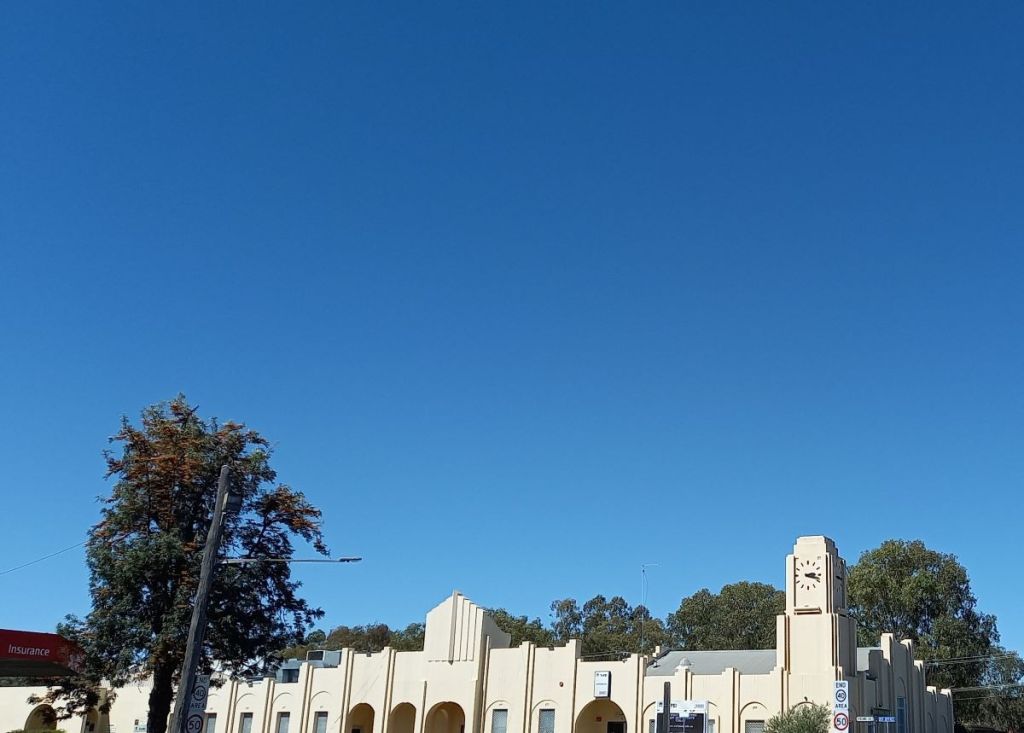
And just in case you missed it in earlier photos – here is the blue, cloudless sky of Moree. Great for harvesting crops, not so great for growing them.
There are a number of art galleries and exhibition centres in Moree, three of which feature Aboriginal art but all of those closed on this visit. The Dhiiyaan Aboriginal Centre which houses many artefacts and documents, including family records, offers an informative video, but we were too late in the day and the centre is closed on Saturdays. We settled for a good look around The Moree Gallery, which is more like an eclectic store of artisan works. It is also worth keeping eyes open as one drives around, as there are impressive murals in some of the unlikeliest places, such as the external walls of random businesses.
Satisfied we had given our exploration a good shot for one day, we ambled back to our motel and dinner. Tomorrow is another day…
Here are a couple of maps to orient you on our drive route so far:
An overview of New South Wales
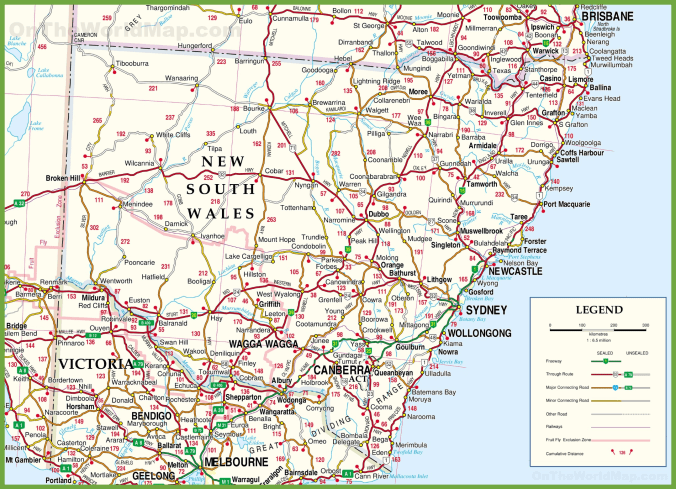
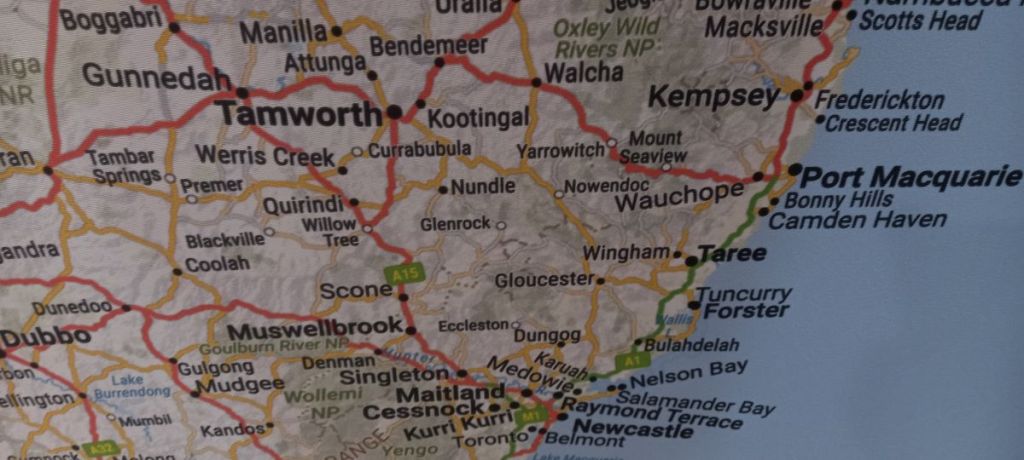
The section from near Belmont to Tamworth up the A15 with a north-east diversion at Willow Tree:
The section from Tamworth to Moree directly north until heading due west just around Warialda. If you look back at the overview map you see we are getting close to Queensland at this point.
 GWEN WILSON, Author, aka The Reluctant Retiree
Hi Gwen,
I do a photo challenge called Thursday Doors. I a photo from Moree I couldn’t remember what the building was used for. I did a search and your photo of the Lifehouse Church came up.
I borrowed your little history piece, with acknowledgement of course.
Thank you
Brian
LikeLiked by 1 person
Thanks so much for taking the time to contact me and let me know you were using “my” text (actually quoted from a leaflet from the information centre). I’ve been so busy lately but finally took the time to have a look-see around your site and note it is Dan Antion who runs Thursday doors. And Crystal Truelove and a few other familiar names also comment. I’m familiar with them from other blogs and sometimes on my own stories.
If only I had the time to interact with everyone out there in my blogging circle 🙂
LikeLiked by 1 person
You’re welcome Gwen.
Post comments do take time as well as reading other blogs.
I am addicted to photo challenges but hey a bushboy has to do whatever he can 😁
Drop me a line if you pass through Grafton sometime
LikeLiked by 1 person
Closest I expect to get to Grafton this year is Woolgoolga in October. But who knows? Meanwhile, here is a little story of Grafton I wrote back in 2019. 🙂
LikeLiked by 1 person
Thanks for the link Gwen. It’s good to see a tourist perception of Grafton.
LikeLiked by 1 person
Hope I didn’t say anything out of turn.
LikeLiked by 1 person
Not at all. Too much of the history of Grafton has been demolished sadly
LikeLiked by 1 person
As the daughter of a Bank of NSW officer I take offence at the reference to that bank branch closing forcing customers on line and no such reference made re the next ex-bank you depict, albeit probably closed a long time ago. Balanced reporting is what we want! Joke Joyce. 😉
Seriously, I enjoyed your post. I love photographing country town buildings. Pubs can be interesting. I love seeing old bank buildings put to good use. They are so solid. So many are cafes, galleries, antique shops.
As another commenter said yarn bombing is a worldwide thing – sometimes (perhaps initially?) done as a guerilla act but often coordinated. It’s been an annual activity at the National Arboretum in Canberra, done by volunteers.
LikeLiked by 1 person
It’s only taken me a year to answer this comment. I realised it was in light jest, but it got me thinking, and I wanted to check a few facts. More immediate tasks kept getting in the way.
You are right, the CBC merged with the NAB in 1982, vacating its gorgeous building, which went on to become the Bank Art Museum.
However, the Westpac had only closed six months before our visit, and that closure was still topical. That must have been what I picked up on and replicated in my blog post. Here’s some sentiment at the time:
https://gunnedahtimes.com.au/2023/03/02/spotlight-on-bank-closures/
And thanks for the feedback on yarn bombing. Not something I’ve come across local to where I live.
x G
LikeLiked by 1 person
Pingback: 3. A full day in Moree | The Reluctant Retiree
No Gwen, it’s the details that are so very interesting. And the bank closures and the treatment of the aboriginals and other historical disasters that we would like to forget.
LikeLiked by 1 person
Thank you for the reassurance John Paol 🙂
LikeLike
Beautiful there –
LikeLiked by 1 person
Thank you. Many more beautiful and unique scenes to come.
LikeLike
I never thought I would see a bank that looked nice. But then I never thought a hot spa would be shut down. I am glad you showed us there is more to Moree than the spa, Gwen.
LikeLiked by 1 person
Those major banks had to look like places it was safe to store your money, I guess.
The Moree spa is quite a complex, so I guess they were refurbishing. Later in the trip we went to a different one which was just a cemented hole in the ground.
Wait till the next Moree post – we went pig racing, giggle.
LikeLiked by 1 person
Closed banks and yarn bombing of trees are world wide phenomena. I enjoyed your bore/hole in our plans wordplay. It was a shame about the closure but the buildings tour was a good one. Your take on the vote would be interesting
LikeLiked by 1 person
Thanks Derrick! I picked up some information about the referendum at the Aboriginal centre – pity such literature hadn’t been more widely circulated. But even the Aboriginal employee at our motel hadn’t made up her mind which way she was voting right up to the day. The vote went down. I’m hoping to have time to expand more.
LikeLiked by 1 person
I am amazed at the distances you cover. I enjoyed the tour of the historical buildings.
LikeLiked by 1 person
Yep – New South Wales is a large state, and we haven’t even started on Queensland or Western Australia yet!
Glad you enjoyed the buildings. I wondered if I’d gone into too much detail.
LikeLike